
What if consciousness isn’t a mysterious substance that arrived late in evolution — but a toolkit that life has been building for four billion years?
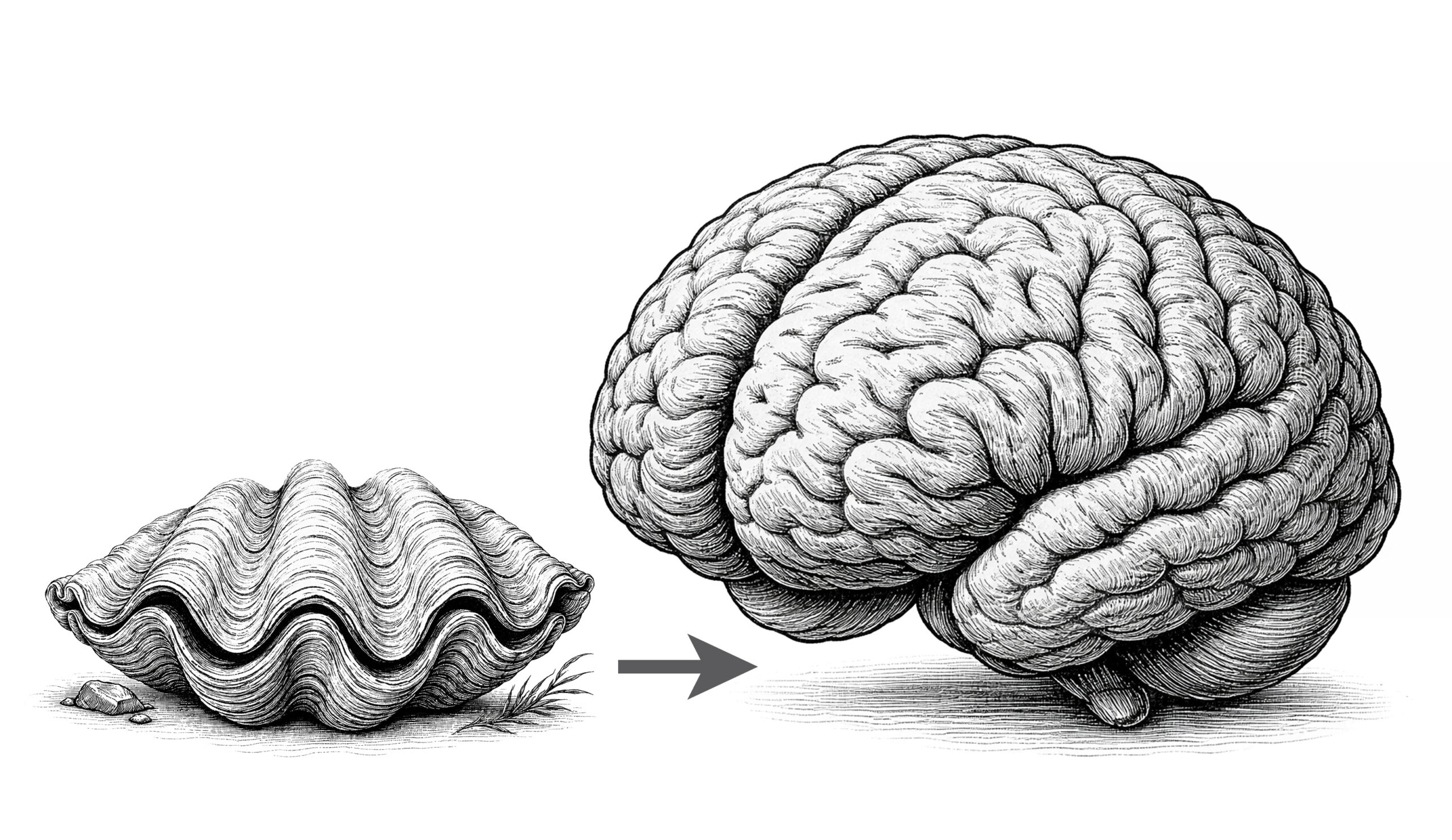
Clam OS starts with a thought experiment: what would it take to build a mind out of clams? Not by making them smarter. Not by giving them anything they don’t already have. Just by connecting enough of them together — the right way, in the right arrangement — until the network itself became something none of the individual clams could be.
From that question, the essay traces ten tools evolution discovered on the way from the first self-replicating molecule to the human mind: memory, boundary, sensation, coordination, surplus, priority, attention, recall, simulation, and story. Each one conserves what came before. Each one opens something new. The clam is running the first four right now. The crow has seven or eight. You have all ten — plus the recursive depth to look back at the stack and have an opinion about it.
Our minds are not made of clams, but of about 86 billion neurons — tiny units, far simpler than clams, but when networked, able to process and store every thought and memory that makes us who we are. We are not descended from clams, nor do clams think anything like us. But we are made of the same stuff, running the same foundational logic. And yet when that same material is organized into human minds rather than clam bodies, it builds civilization.
This is not a story about how special we are. It is a story about what we share with everything alive — and what it actually took to get here.